

MSc Information Technology Management
Apply now:

Course overview
-
Starts:Jan 2027
-
Duration: 1 year
-
Mode:Full-time
-
Fees:UK: £9,750 International: £18,500
*Fees apply to 2026-27 entry only.
Master data integrity
This course blends technical, managerial, and ethical perspectives to address challenges in data privacy, intellectual property, and cybersecurity. Students explore frameworks for protecting digital assets, ensuring compliance with evolving regulations, and fostering responsible innovation.
Graduates will be equipped to lead digital infrastructure and transformation strategies across industries such as finance, manufacturing, retail, media, and creative agencies.
Build infrastructure industry needs
Design and implement advanced digital infrastructure and cloud management solutions that meet the evolving needs of industry
Lead technology, projects and people
Develop leadership capabilities for managing information technology infrastructure, resources and projects across diverse organisational contexts
Keep data secure and trusted
Apply advanced cyber security and risk management practices to protect digital assets and ensure data integrity and confidentiality
Research, analyse, visualise, decide
Utilise research, data analytics and visualisation techniques to generate insights that support innovation and creative decision-making
Make ethical, informed IT decisions
Critically evaluate information technology governance, project management frameworks and data management tools to inform ethical, strategic and operational decisions
More reasons to choose this course
This course combines business and IT management principles, focusing on how technology can optimise operations. The programme emphasises the management of technological resources, cybersecurity, and governance, enabling professionals to lead organisations in a digital world where innovative technology is key to success.
With a holistic approach, this course integrates technical, managerial, and ethical perspectives, addressing challenges like data privacy, intellectual property, and cybersecurity. Students will explore the protection of digital assets, compliance with evolving regulations, and best practices for responsible innovation.
This postgraduate course prepares students for leadership roles in IT management, equipping them with the skills to strategise, secure, manage, and innovate IT solutions that enhance business performance. Graduates will be able to align IT initiatives with business strategies, lead projects effectively, and apply advanced problem-solving skills to meet IT challenges across various sectors.
Teaching sessions are Monday to Friday, between 9:00am and 9:00pm, with some evening sessions included.
Entry requirements
Home
A lower second-class honours (a 2:2, or equivalent non-UK qualifications) or higher in a relevant subject, or an equivalent professional qualification in a related subject. You will also need to submit a copy of your Curriculum Vitae (CV)/Resume.
If you are applying directly from an undergraduate degree course without experience or professional practice, you must be able to demonstrate a good knowledge of your chosen subject area.
International
If you have international qualifications, please view our entry requirements per country. Along with your academic qualifications, you will also need to submit a copy of your Curriculum Vitae (CV)/Resume.
In order to be eligible for this course, you will need to be a competent speaker and writer of English. If you require a Student Visa you need to provide us with an IELTS or equivalent English language qualification, which demonstrates a minimum of 6.0 (with a minimum of 5.5 in each sub test) or CEFR Level B2 in each component. Please contact [email protected] for more information.
Selection criteria
We welcome suitably-qualified applicants who are able to demonstrate a good level of skills in areas associated with this subject. To get a holistic view of your ability and aptitude to succeed on the course, we will also consider your enthusiasm and interest in the subject area, how you manage the creative process, previous study and your professional skill-set.
Applications are welcome from a wide range of backgrounds and experience including from students who may not necessarily possess formal academic qualifications. It is important that applicants can demonstrate an aptitude for learning and continued professional development through a research-led approach.
Industry connections

Proud members of BCS
Develop industry-relevant skills and professional awareness through a strong connection with the UK's Chartered Institute for IT.


Location and facilities
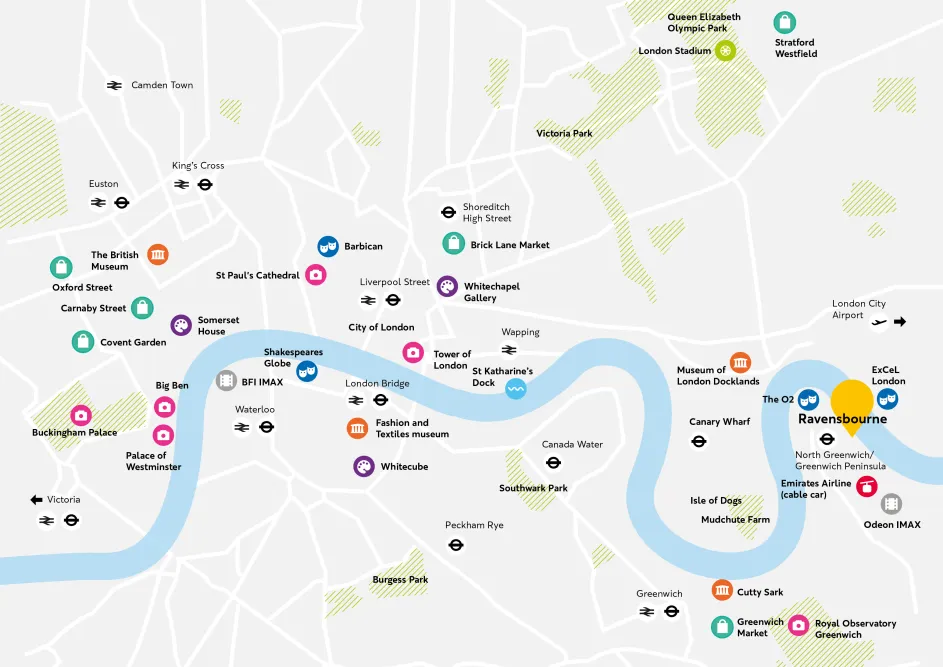
Our prime location beside the iconic O2 gives students direct access to one of London's most exciting centres for innovation, business, and opportunity.

Ravensbourne R1 building and campus
Discover our campus which brings together a range of courses at the intersection of business, technology, and creativity.
Located in the heart of the Design District and next to London's iconic O2 Arena, you'll study in a vibrant hub of innovation. Find out more about our campus and its cutting-edge facilities here.

iMac suite at Ravensbourne
iMac suite at Ravensbourne University - ideal for design students and computing students.

Study spaces
Dedicated spaces designed for focused independent study, research and group work, giving students a comfortable environment to develop their ideas, analyse data and collaborate on projects.

Library
Our library offers a wide range of print, digital and multimedia resources to support learning, teaching and research - find out more