Louis Morel BA (Hons)
Biography
Can you tell us about your career journey since graduating from Ravensbourne, including any roles you secured while studying?
I graduated from Ravensbourne in May 2023 with first-class honours from the Digital Television Production BA Honours course. During my studies, I worked as a camera operator on multiple sports events, such as the national swimming championships final, the cricket T20 Vitality blast and even some cage fighting! However, the one that sticks out the most was working in Sharm El Sheikh, Egypt, on the COP27 climate conference as a technical operator, running streams for the United Nations Development Programme. This was a very challenging but brilliant experience working in another country. I was definitely put out of my comfort zone and had to learn a lot in a very short space of time, but it was a wonderful opportunity and one I am glad I took.
Whilst in my final month of studying, I was approached by a recruitment company with an offer to interview for a full-time job as a Multi Skilled Operator at a national news company. Although this wasn't something I had initially imagined myself going for, I accepted, and within a matter of days, I was at an in-person interview with GB News in Paddington. I managed to get the job, and by June, I was starting. The role was a very busy one, from floor managing Breakfast shows with Eamonn Holmes and evening shows with Nigel Farage to operating the MCR, quality controlling guests and liaising with major news networks on live events and even getting myself in the gallery to learn from the directors and operate the robotic cameras, all my roles were part of a bigger machine that managed to get breaking news on the air every day. After a year as an MSO, I was lucky enough to get the opportunity to move into the gallery as a Junior Director. This was another fantastic experience; it is a difficult job that pushes you to your limits and tests you on a daily basis. I adored working with so many talented people to get the news out every day, and the feeling of being the one responsible for how the show looks was exhilarating. In this role, I found what my passion within television is, and I couldn't be more grateful for that.
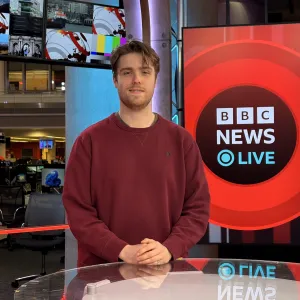
In the spring of 2025, I left Paddington and GB News as I got the opportunity to join the BBC as a production specialist, launching their brand new streaming operations. This role, which I am still currently in, is a very exciting one. I am working in the heart of the British media landscape, in a team full of the best and brightest journalists in the country. It is a new product that will hopefully be the future of televised news, and I feel very humbled to be a part of that. In my role, I lead the technical output, so I am taking the best parts of both my MSO and directorial experiences and melding them together to work in a new way. It is still a bit of a pinch-me feeling that I am here, and without my foundations at Ravensbourne, that definitely would not have been possible.
What initially attracted you to study BA (Hons) Digital Television Production at Ravensbourne, and how did the university support your development?
From a very early age, I knew that I wanted to work in television, as cliché as that might sound. My mother is a makeup artist for film and TV, meaning that as a child, I would go along to sets that she was working on to say hello and have a nose about. I distinctly remember meeting Basil Brush in Maidstone studios and having the illusion shattered that he was not a talking fox but rather a middle-aged man with sore knees. However, this did not deter me, and I went on to study film at A-Level. As I got older, my mum continued to emphasise the amazing reputation that Ravensbourne had in the industry, and sure enough, as I started doing some running work, I would meet lots of people on sets who would recommend Ravensbourne to me as they had gone there. I had real-world, first-hand accounts of people working in the industry, which gave me a real sense of security, alongside my visit there on Open Day, that Rave was the place for me.
And once I stepped through the door, I knew that my intuitions were correct. On day one, I met my lecturers and signed up for extracurricular classes to gain the most from their brilliance. We were in the midst of Covid during my first year, and so had limited hands-on time with the kit, but we made the most of it, and all of the lecturers did their best to still support us through this difficult period and still give us the best experience possible. Having to make the most of our limited time was a blessing in disguise; it pushed me to get to know people quickly, value my time with the kit and concentrate even more than I otherwise may have. It is a tricky thing to navigate, learning in those circumstances, but Ravensbourne were excellent at making our course engaging; they levelled the playing field, as someone who had never picked up a camera or edited using industry-standard software. I felt it was encouraging to know that by the end of my first year, all of the students were on the same page, ready to explode into the second year once restrictions were slightly lifted.
What types of projects did you work on during your course, and is there one experience that particularly stands out?
During my studies, Ravensbourne made a big emphasis on variety in our learning. The television industry has so many avenues to explore that it can feel daunting as to where to start. I joined the course thinking I would be a lighting designer and discovered, through my years at Rave, that I had passions elsewhere, passions that I still have yet to fully explore. We began with studio magazine shows. Ravensourne has a wonderful studio space and an industry-standard gallery that we were able to make the most of. We would spend lessons switching roles, making sure that we had a chance to operate in any capacity. I would present shows, direct them, floor manage, you name it, we had the chance to see what was right for us. That was immensely valuable. I learnt skills in that first module that I still use in my job today. We also covered short films, documentaries, multi-platform films, and any type of content you could imagine; we had a go at it. Not only this, but we explored the other side of the industry, creative writing, formats, pitches, and how to get your idea from start to finish. These were equally brilliant in teaching us the value of communication and development. All of these modules were delivered to us by industry professionals who genuinely cared about what we were creating; their expertise and depth of knowledge shone through in their teaching and inspired us to create some fantastic work.
If I were to pick one project that stuck out, it would be the studio masterclasses that we did with a guest lecturer, Del Brown. He came in during our second year to give us an insight into how to create dynamic, entertaining and technically excellent content. Del has a way about him to make those who want to learn feel very appreciated. He taught us the importance of punctuality, of manners with your colleagues even when the pressure is on, of delivering technically excellent shows in an approachable way and many other things. I think this module opened my eyes a lot to the potential that my classmates had. I think if I could get any prospective students to experience one module of mine, it would be this one.
How did Ravensbourne’s industry links and live briefs help you build professional connections and gain real-world experience?
I started gaining industry experience prior to joining Ravensbourne, but this experience didn't have a particular direction. It was a lot of running work, just getting to meet people and learn a lot about on-set etiquette. That was incredible, but it wasn't until the second year when the very generous, talented and kind Joey Houldsworth asked me to work as a camera op on a sports event he was directing. Joey was in the year above me, but having helped him as a stand-in on his end of second year production, we got to know each other. Without his generosity, thoughtfulness and love for what he did, I definitely would not be who I am today, and so I am forever indebted to him. That's the wonderful thing about Ravensbourne, it is full of brilliant people waiting to help you get into a very difficult industry. The University was keen that these experiences did not distract me from my studies, but without them, my skills in class would not have been contextualised in the same way. They helped to sharpen my skills and allowed me to feel confident when it came to important University productions. That one-camera gig led to meeting other professionals and working with them in all sorts of capacities. Those live industry experiences are invaluable, and I hope that I was able to pay that forward to others who came after me.
What advice would you give to current students hoping to work in television and live broadcast production?
If I had to give some advice to current students, it would be to make mistakes. Making mistakes, especially at University, is the number one best way to learn. We all have to start out somewhere, and there is no shame in saying that you're unsure of something. You are in a place of learning after all, and you have wonderful people around you to help. Promise yourself that if you're ever in the fortunate position of knowing what you're doing, you'll help those who don't. A production is only as strong as its weakest link, and we all rely on each other to make things work. Get to know the people you don't know; you might find they have a brilliant, creative mind just waiting to be explored. Ask questions, take time to help on other shows, embrace doing a role that you didn't think was right for you, go to the extra classes and be present in them, say yes to opportunities that put you out of your comfort zone. You will soon work out that your University experience will be what you make of it. It goes by so quickly, and soon enough, you'll be sitting on the sofa at home watching your name roll down the credits of a show with an immense sense of pride and satisfaction. Keep the faith, it's the journey, not the destination. Finally, just like my dear friend Joey always was, be kind.
- BA (Hons) Digital Television Production
- Graduation date: 2023
Study the same course as Louis
Louis studied BA (Hons) Digital Television Production