Public information and university policies

As a university, we're committed to openness and transparency in everything we do.
Key documents
Appeals policy
Ravensbourne has a duty to ensure that it has fair and transparent procedures, which are accessible to all students, for governing academic appeals.
The term ‘appeal’ refers to the process of reviewing the decisions of Assessment Boards on the results of individual students.
Ravensbourne University London
Staff and student policies
- Acceptable Use Policy
- Admissions Appeals and Complaints Procedure
- Anti-Bribery Policy
- Data Protection Policy
- Equality Diversity and Inclusion Policy
- Fair Processing Notice for Students
- Fee Information 2024-25
- General Academic Regulations 2025/26
- General Academic Regulations 2026/27
- General Academic Regulations: Summary of Changes (2026/27)
- Health and Safety Policy
- Harassment & Sexual Misconduct Statement and External Complaints Procedure
- Modern Slavery and Human Trafficking Policy
- Ravensbourne Staff Values and Behavioural Framework
- Staff Recruitment Policy
- Student Terms and Conditions
- Tuition Fee Policy
- Whistleblowing Policy
Transparency information
This content tells you the number of students who attained a particular degree or other award, or a particular level of such an award, on completion of their course with us.
It shows these numbers by reference to:
- The gender of the individuals to which they relate
- Their ethnicity
- Their socio-economic background
The data contained in the tables in this workbook have been produced using Ravensbourne's signed-off HESA Student Record or Individualised Learner Record student data submitted to the Designated Data Body or the Department for Education for the 2023-24 and 2024-25 academic year and includes any amendments submitted before 02 March 2026.
Further information
For more information on the Transparency information 2026, please see the specification and publication guidance document available from the OfS website - explore the full document here.
The data has been rounded as follows:
a. Denominators or headcounts have been rounded to the nearest 10.
b. Percentages been rounded to the nearest 0.1.
Any data point that is not reportable will be replaced with a symbol to indicate why, applied according to the following hierarchical order:
- [none]: where there are no students in the population (or two or fewer).
- [low]: Low numbers of students, where there are more than two but fewer than 23 students in the denominator.
- [DPL]: Data protection for low numerators, where data has been suppressed for data protection reasons. The code [DPL] has been used to indicate where the data has been suppressed due to a numerator or headcount that is less than or equal to two, meaning that the percentage will take on a value close to 0 per cent.
- [DPH]: Data protection for high numerators, where data has been suppressed for data protection reasons. For the percentages, the code [DPH] has been used to indicate where data has been suppressed due to a numerator that is greater than two but is within two of the denominator.
Financial information
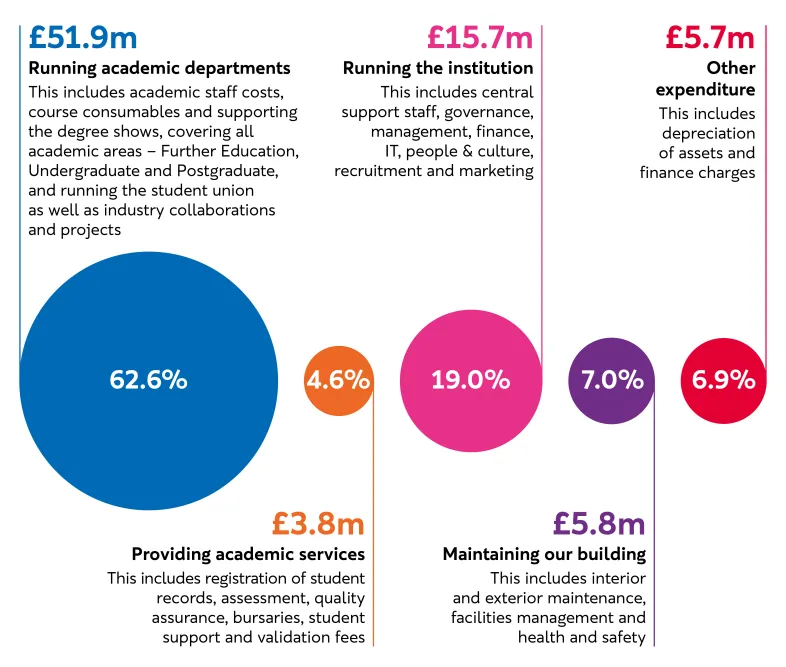
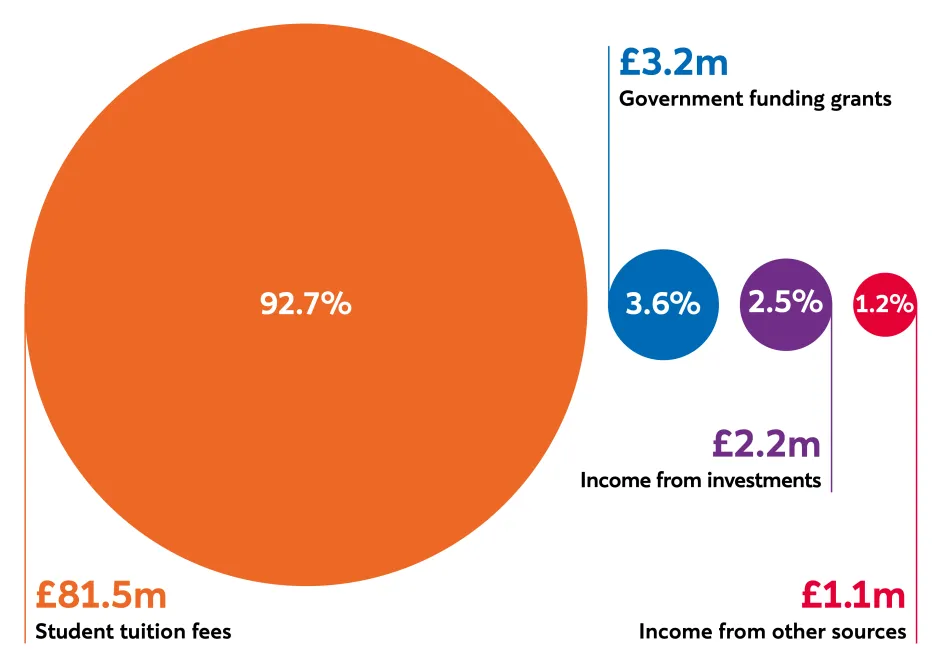
Universities are subject to the Office for Students requirement to be transparent about value for money for its students. The following information sets out how the University’s finances work – where our income comes from and what we spend our money on.
Where do we get our money from?
Where is our money going?