Fashion & Architecture join Zaha Hadid Foundation
Publication date:
In January, a cohort of Ravensbourne University London final-year students from the Department of Architecture and the Department of Fashion took part in the longstanding cross-disciplinary partnership with the Zaha Hadid Foundation (ZHF), working on an ambitious live design brief that culminated in a public exhibition at the Foundation.
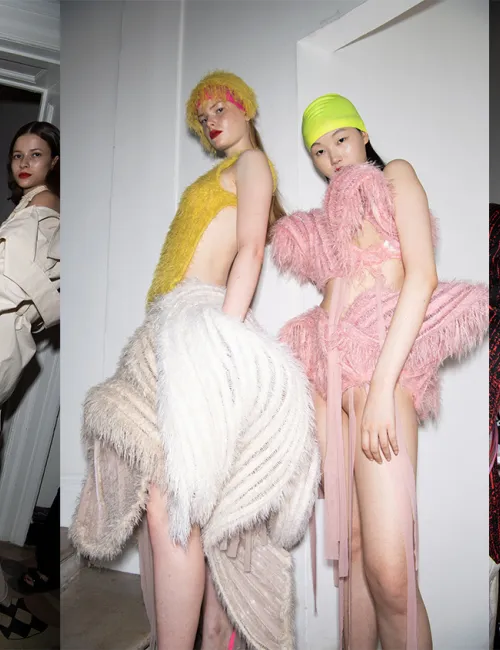
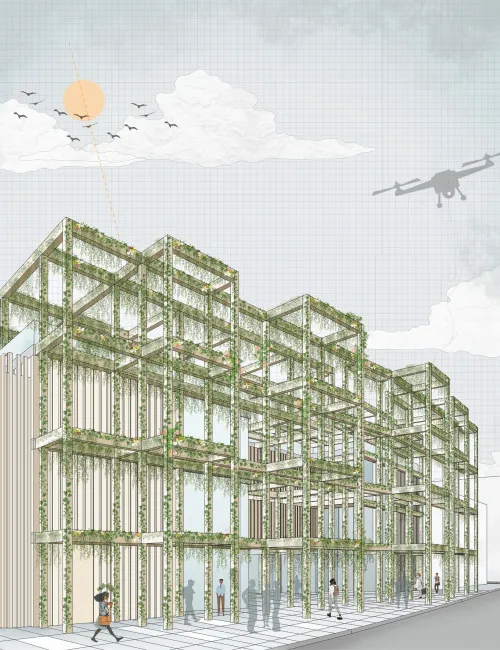
In this exciting and collaborative project, Architecture students were tasked with designing a space that explores how an individual connects to their clothing and how architecture can generate creative responses to the way that clothes are stored and celebrated. Fashion students responded by developing concepts that examined how individuals experience clothing within that spatial environment. Each student selected one of three Space x Concept narratives to guide their work:
Public exhibition × An art piece
Retail space/shopfront × A ready-to-wear piece
Private wardrobe × A bespoke piece
Photos ZHF
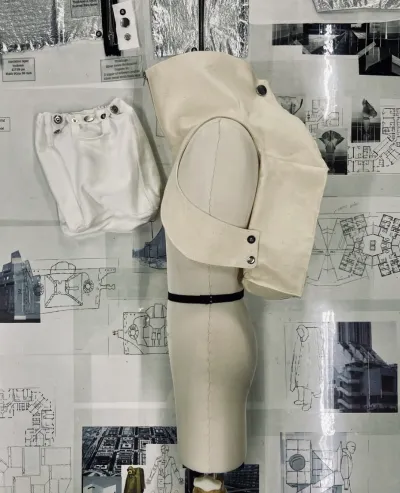
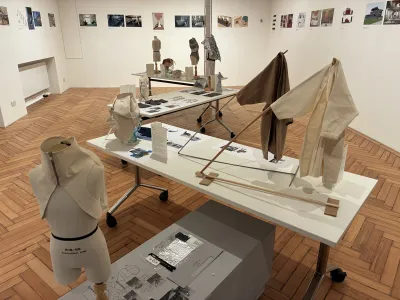
The brief was developed in collaboration with the ZHF, as Zaha was well-known for being an advocate for distinct fashion items and her wardrobe. The exhibition was established not only to celebrate the excellent work of the student from Ravensbourne, but also to celebrate the oeuvre of one of the most influential women in architectural history, making a huge impact on a male-dominated profession. This is significant due to the recent celebration of the 115th year of International Women’s Day, who advocate for a world free of bias, stereotypes and discrimination, encouraging a mindset of generosity and collaboration.
A total of 38 students presented their final outcomes across courses, launched at an exclusive Private View and later opened to the public at the ZHF Clerkenwell Studio throughout February 2026.
As part of the celebration, the Zaha Hadid Foundation team cast individual votes to select standout submissions. The awarded students were:
GOLD AWARD – Liam Curtis
SILVER AWARD – Henriette Lindgren
BRONZE AWARD – Jasmin Jiali Liu & Elvis Barberio
HIGHLY COMMENDED – Rachel Gibson & Alkistis-Athanasia Papantoniou
Reflecting on the collaboration, Aric Chen, Director of the Zaha Hadid Foundation, shared:
“As an educator herself, Zaha always encouraged students to push boundaries and creativity, and to see so much of this happening, drawn from so many vantage points and in so many inventive ways, would have certainly made her proud. We’re grateful to have been able to play some small part in supporting these Ravensbourne students.”
Thida quote
It was a privilege to work alongside the Architecture and Zaha Hadid Foundation teams on this multi-faceted project. Students were challenged to consider architectural principles and Zaha’s fashion archive to create dynamic outcomes. This was reflected in the variety of clothing, accessories and art pieces produced using traditional pattern making, machine and hand sewing, 3D printing, digital animations and virtual interactivity. Having the work exhibited in a gallery context also provided an insight into curation and public display which may broaden career opportunities.”
Elliot quote
The Zaha Hadid Foundation has been an inspiring collaborator throughout this project. Our students explored the work of Zaha Hadid and experienced the history of the building through a guided tour. Students were then challenged to reimagine the future of the former school building, once home to Zaha Hadid Architects and now the foundation, through bold design proposals. Projects included concepts for an exhibition gallery, a retail space, and a private wardrobe inspired by influential fashion designers, past and present.”
This collaboration continues to demonstrate Ravensbourne’s commitment to industry-engaged learning, giving students the opportunity to work alongside leading practitioners and develop work for real-world contexts.