Ravensbourne University London students recognised for excellence at On Air 2026
Publication date:
Ravensbourne University London students have been recognised at On Air 2026, following a live broadcast that brought together emerging media talent from around the world.
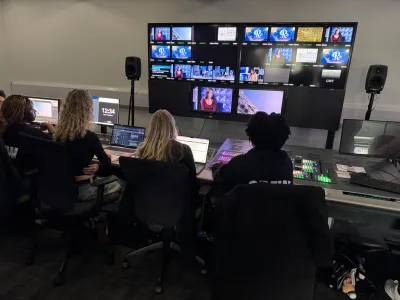
On 22 October, Ravensbourne produced an hour of live programming as part of an international, student-led broadcasting initiative connecting universities and broadcast professionals across six continents.
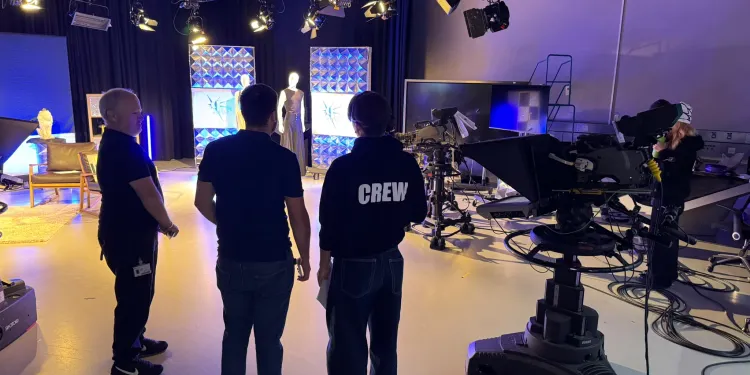
The university’s Rave Hour aired live from 9.20am to 10.20am BST, showcasing Ravensbourne’s diverse creative community and giving students the opportunity to put their skills into practice in a professional broadcast environment.
The event also celebrated student achievement, with Ravensbourne receiving recognition for broadcast engineering and a live art installation. Media Talent Manifesto, the organisation behind On Air, received a Royal Television Society (RTS) Technology Award for Collaborative Team.
Student achievements
Ravensbourne students received recognition across two categories at On Air.
Outstanding Student in Role – Dainis Baukus
Dainis Baukus, a third-year BSc (Hons) Broadcast Engineering student, won the Outstanding Student in Role award, recognising his contribution to the production.
Innovation in Broadcast – Alma Live Art Installation
The Alma Live Art Installation won the Innovation in Broadcast award. The project involved BA (Hons) Digital Film Production students Nadir Chowdhury, Karina Pishori, Jack Barrault-Lovett, Samuel Monte and Bela Venturin Lage, alongside Richard Whitby.
The achievements reflect the creativity of our students, who took on several responsibilities throughout the production, supported by staff and academic teams working behind the scenes.
Learning with industry
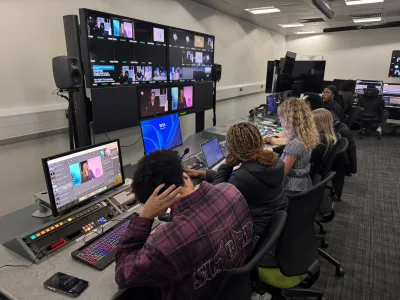
On Air gave students the chance to work on original programming for an international audience, taking responsibility for the editorial, creative and technical demands of live broadcasting.
On Air 2026
Bill quote
What makes On Air so valuable is that this isn't a simulation or a classroom exercise. Our students are producing a real live television programme, working to a fixed transmission time and delivering content to an international audience. Having hosted the entire global broadcast last year, we're delighted to be involved again. It's a fantastic opportunity for our students to put their creative and technical skills into practice, experience the pressures and excitement of live production, and become part of a global community of emerging television talent.”
Following Ravensbourne’s role as the central broadcasting hub for the inaugural event in 2025, this year’s main hub moved to the University of Westminster’s Harrow Media Campus. Ravensbourne remained an active participant, producing its own live hour as part of an expanded international programme.
The 2026 event brought together approximately 1,500 students internationally, with contributions from 48 locations across six continents and around 107 hours of programming across multiple themed channels.
Ravensbourne’s Rave Hour focused on culture, celebrating the university’s diverse community and its connections with the wider Greenwich Peninsula. The programme touched on different aspects of university life, with plans including a live music performance, coverage of the short horror film competition premiere at the O2 and a look at the local area through a cultural lens.
Students worked throughout the summer and in the weeks leading up to the broadcast, preparing the programme and coordinating the technical and creative elements required for a live transmission.
On the day, staff and students arrived at 6am to prepare for the hour-long broadcast, which went live without a hitch.
A global collaboration
On Air was created by Media Talent Manifesto, co-founded by Carrie Wootten, to connect emerging talent with opportunities to demonstrate their skills beyond the university environment.
The inaugural broadcast in October 2025 saw Ravensbourne take on a central role, managing the technical and editorial operation across the 24-hour transmission.
The project brought together students and industry partners, with support from organisations including Amazon Web Services, CNN, ITV Studios, Vizrt, NEP and Clear-Com. It also explored emerging broadcast technologies, including cloud-based production workflows, AI-assisted translation and the Time Addressable Media Store developed by BBC Research & Development.
This year’s broadcast builds on that collaboration, giving learners further opportunities to work across disciplines and contribute to a global creative production.
The recognition received by Media Talent Manifesto at the RTS Technology Awards further highlights the value of collaboration between education and the broadcast industry in creating opportunities for emerging talent.
Ravensbourne University London is proud to continue its involvement in On Air. It has provided students with opportunities to work on live productions and develop the experiences needed to progress in the creative industries.