Built for industry: Diana Jablonskaite
Publication date:
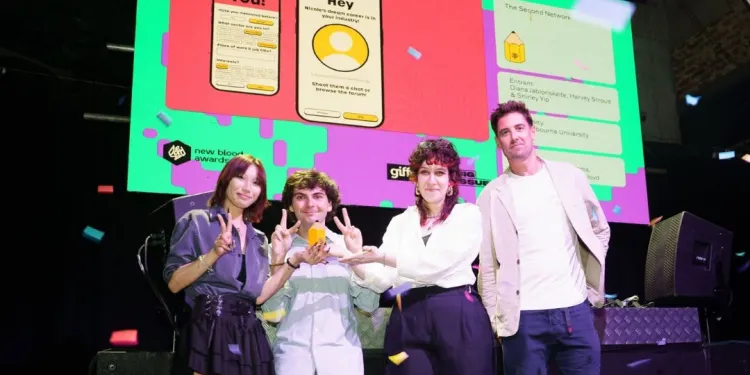
The latest instalment in our Built for Industry series features Ravensbourne graduate Diana Jablonskaite, who was awarded a D&AD New Blood Yellow Pencil alongside Shirley Yip and Harvey Stroud for their campaign, The Second Network.
We caught up with Diana to hear about the project and how working on a brief for giffgaff and the Big Issue has shaped her approach as an emerging creative.
Diana quote
I think the biggest thing Ravensbourne has given me is the confidence to be curious. It taught me that developing as a creative isn’t just about learning a set of skills. It’s about finding the things that genuinely interest you, developing your own perspective and being open to the people and ideas around you.”
Could you tell us a little about the project you’re being recognised for, and what your role was?
My D&AD entry was created alongside two other incredibly talented students, Shirley Yip and Harvey Stroud. In our final year, part of our curriculum was to submit work to the D&AD New Blood Awards. From the many briefs available, we chose the giffgaff × Big Issue brief, “Using the power of connection to help young people in poverty.”
We worked extremely closely together throughout the project and all felt strongly about the core message: how poverty can limit young people’s opportunities long beyond their immediate circumstances.
Our idea explored how we could break that cycle by giving young people access to some of the same support and opportunities that we had as university students, without forcing them to choose between studying, supporting themselves and supporting their families.
A big part of our thinking came from our own experience at Ravensbourne. Our tutors have created such a strong network around us, giving us access to opportunities, advice, industry connections and people who believe in our potential. We wanted to explore what it might look like to give that kind of network to someone who doesn’t otherwise have access to it.
What inspired the project, and what was the creative process like from the initial idea through to the finished work?
The project was inspired by our own experiences as university students and the opportunities that come with having access to a strong support network. We started thinking about how different that experience can be for young people living in poverty, particularly when education can feel financially impossible. We became interested in “survival jobs” – work that helps you get by but can make it much harder to pursue education or build a career outside of that cycle.
We didn’t want to approach the problem purely from our own perspective, so a big part of our process was speaking to people who mentor and support young people, as well as drawing on the access we had to contacts working across the industry. Hearing from others on both sides helped us understand what youngsters need from a network, alongside what people with experience and connections can realistically offer.
Especially now, digital connection is an incredible tool for opening up opportunities, but we felt there was something missing. People still crave human connection – to feel seen, understood and like someone believes in them. That became really important to our thinking. We were interested in connecting young people to information or opportunities and explore how we could connect them to different individuals.
From there, we started asking what it would look like to give young people the same kind of network and opportunities that we had been given at university. The idea developed through a lot of discussion and experimentation between the three of us. We kept coming back to connection in its broadest sense – to people, opportunities, knowledge and support, which became the foundation for the final concept.
What was the most valuable thing you learned from working on the project, and were there any challenges you had to overcome?
The most valuable thing I learned was the importance of persistence. We definitely had our ups and downs, and there were times when it felt like we were going around in circles, revisiting the same ideas and questioning whether we were actually getting anywhere. Looking back, though, it was more of a funnel than a circle. Every iteration helped us narrow things down, strip away what wasn’t working and get closer to what the idea actually needed to be.
A big part of that was learning to trust each other. We had to be comfortable challenging one another and letting go of ideas without taking it personally. The project worked because we had a team where we could push each other, be honest when something wasn’t working and still trust that we were all working towards the same thing.
The biggest challenge was probably resisting the urge to settle too early. Learning to stay with an idea, keep questioning it and trust the process was probably the most valuable thing I took away from the project.
How has your experience at Ravensbourne, including working with your tutors, peers or through industry opportunities, helped you develop your skills and approach to your work?
My experience at Ravensbourne has really shaped both my skills and the way I approach creative work. A huge part of that comes down to my tutors, Paula Williams and Steve Lloyd. Their classes were guided, but also incredibly freeform. We were given the structure and support to develop our skills, but there was always room to follow our own interests and develop a personal perspective rather than being confined to a rigid learning structure.
They also facilitated so much access to the industry. Our classroom often felt like a revolving door of talent. Alumni, creatives and people from across the industry would come in and share their experiences, and we were the sponges soaking it all up.
My peers were a huge part of that too. Being surrounded by people with completely different interests and ways of thinking meant there was always someone to challenge an idea, introduce you to something new or push you to take your work further.
I think the biggest thing Ravensbourne has given me is the confidence to be curious. It taught me that developing as a creative isn’t just about learning a set of skills. It’s about finding the things that genuinely interest you, developing your own perspective and being open to the people and ideas around you.
What are you hoping to do next, and how do you think this experience will help you as you move towards your career in the creative industries?
I’m hoping to find a place within the creative industries that aligns with my interests and gives me the space to keep exploring. I’m interested in working across branding, art direction and concept-led work, but I’m also still figuring out exactly where I fit, and I think that’s part of the excitement of finishing university.
I’d like to find people I can learn from, work alongside and be challenged by, while continuing to develop my own perspective and experiment with different ways of working. My experience at Ravensbourne has made me realise how much I value being around curious, creative people, and I’d really like to carry that into whatever comes next.
Winning a D&AD Yellow Pencil has given me a lot of confidence going into that next stage. It’s reassuring to know that the way I think and the kind of work I’m interested in can resonate beyond university. More than anything, I think it’s encouraged me to stay curious and not rush into defining exactly what I’m supposed to be.
To find out more about Diana's work, read more here about Ravensbourne's winners at the recent D&AD New Blood Awards.